'I built an agent': what that should actually mean
By James Boone, 20 Nov 2026
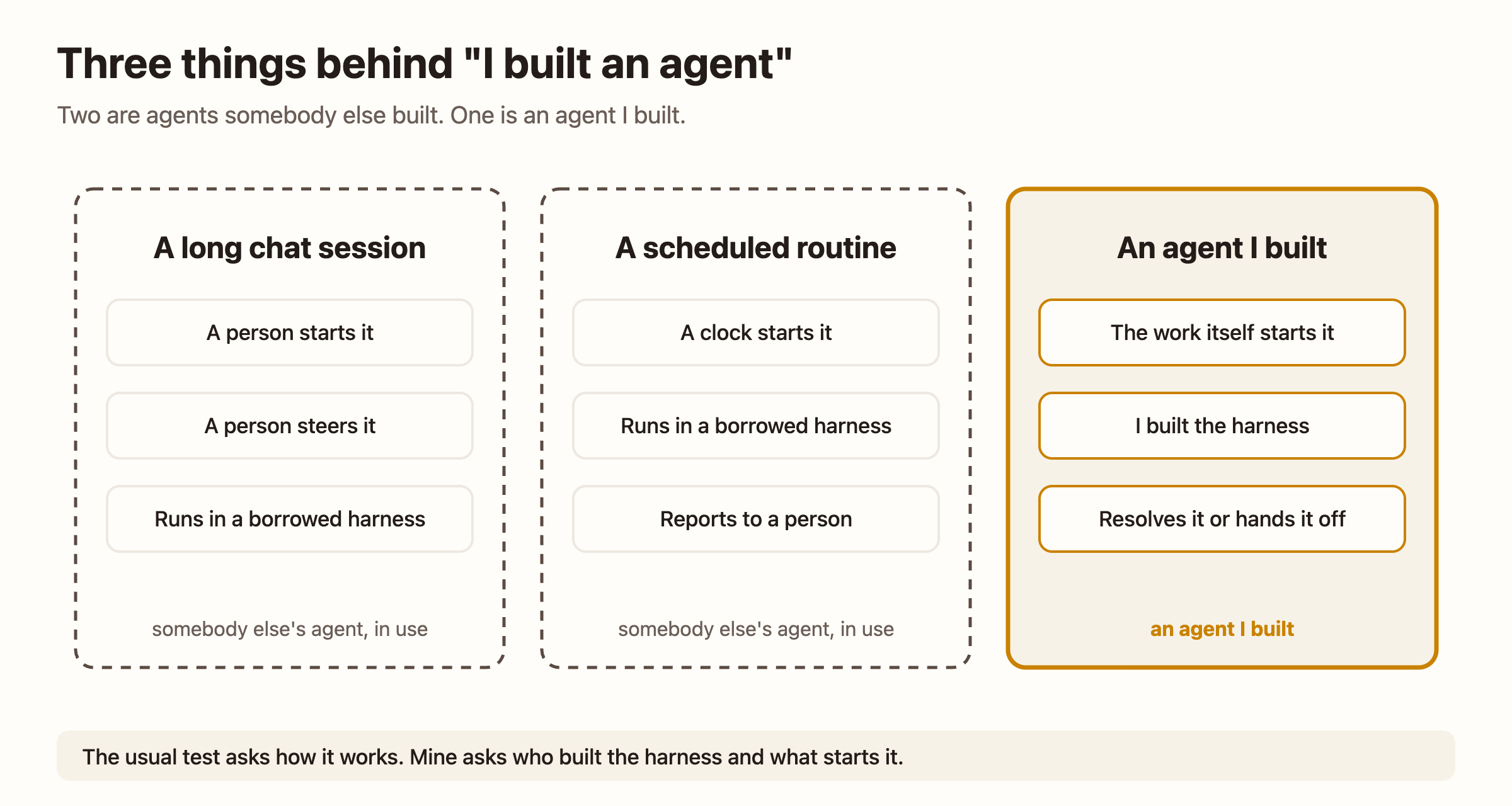
Every week I see someone say "I built an agent" or "I have a team of agents working for me". Usually it is someone on LinkedIn humblebragging. Sometimes what they built is a long chat with a model. Sometimes it is a prompt that runs every morning. Sometimes it is a real one. The phrase is being used to describe several different AI features, but only one of them is actually building an agent.
I run getdaywell.com alone, with AI doing most of the work beside me, and I have built four agents: the product itself, and three that a parent or a customer talks to. This post defines the word, and says what it leaves out. Three more posts describe those three: Felix, the one that answers questions, the support agent that answers email and the integration agent that turns customer requests into work ready for review.
What is an AI agent?
An agent is an autonomous harness that runs a context loop and resolves work on its own.
Four parts of that sentence carry the weight:
- Autonomous. Nobody starts it and nobody drives it. Work arrives and it picks the work up.
- Harness. The code around the model: what the model is shown, what it is allowed to decide, and what happens to its answer.
- Context loop. For every new piece of work it gathers the context that work needs, acts, and is ready for the next one.
- Resolves work. Something is finished, or handed to the right person, when it stops. A reply is sent. A request becomes a brief.
If you start it, steer it or finish it, you are using an agent.
If a clock starts it, you scheduled one.
If you built the harness, the work itself starts it and resolved work comes out, you actually built one.
Is a long session or a scheduled routine an agent?
No. That is Claude, Codex or Muse doing work for you. The agent is theirs, and you are its user.
I use sessions and routines all day. A long session with a model can do remarkable work, but I am the loop: I read what it did and tell it what is next. A scheduled routine runs without me, but nothing arrived to start it: a clock went off, and it makes its rounds whether or not there is work. Neither one is something I built, and neither one starts because a piece of work showed up.
The usual definition is about mechanism: a model that directs its own steps and its own tool use until the task is done (Anthropic's version is the best known). By that test Claude Code is an agent, and I agree. My argument is with the verb. That test describes what the model's maker built. Most of what gets posted under the words "I built an agent" is somebody using it, and trying to sound important. Opening a session is using an agent. Scheduling a prompt is scheduling one. Building one means the harness is yours, the work itself starts it, and nobody has to be in the room. For that to be true it has to be deployed: running somewhere that is not your laptop and not your chat window.
| Who built the harness | What starts it | Who decides it is done | |
|---|---|---|---|
| A long chat session | The model's maker | A person | The person |
| A scheduled routine | The model's maker, with my prompt inside | A clock | It reports to a person |
| An agent I built | I did | The work arriving | It does: it resolves the work or hands it off |
If I counted the way the word usually gets used, I have built 48 agents: 19 operators (the Claude Code sessions that each own one part of the company), 19 scheduled routines, half a dozen standing helpers, and the four I built. That is before the helpers each operator spins up for an afternoon, which I stopped counting. By the definition in this post, I have built four.
48 agents by the loose count. Four by the strict one.
How do I know if I built an agent or I am just using one?
Run five tests. If it fails any of them, you are using an agent, not building one.
- Close the laptop. Does it keep working? An agent you built is deployed. It runs where you are not.
- Who sends it work? If only you can hand it a task, it is your assistant. Daywell's agents take work from parents I have never met.
- Is there a chat box? If you can lean in and steer it halfway through, you are still the loop.
- Whose permissions does it run on? A session runs as you, with everything you can reach. An agent you built has its own narrow permissions, and you decided each one.
- Who is on the hook when it is wrong? You wrote its limits, its off switch and the path to a person, and you find out when it fails.
| Laptop closed | Strangers send it work | No chat box | Its own permissions | You own its failures | |
|---|---|---|---|---|---|
| A long chat session | Fails | Fails | Fails | Fails | Fails |
| A scheduled routine | Sometimes | Fails | Passes | Fails | Sometimes |
| An agent you built | Passes | Passes | Passes | Passes | Passes |
Most people can pass the first test with a scheduled prompt. Very few pass all five, because the last four are not prompting. They are engineering, and they are the part nobody posts about.
Does an AI agent need tools?
Not always. But the agent is always the tool.
Tool use sits inside the picture of what an agent can be. It is not the whole picture. A lot of writing treats it as the test: if the model can call a search or run a command, it is an agent, and if it cannot, it is not. I think that confuses the equipment with the job.
Two of mine make the point. Our integration agent does use tools: it reads public web pages to research an app. Our support agent calls none at all, on purpose. It reads a parent's email with the few facts it is allowed to see, and decides whether to answer or to escalate. That decision is the work. Giving it more to reach for would have made it more dangerous and no more useful.
So tools are optional. What is not optional is that I can hand the agent a piece of work and get it back done. That is what makes the agent the tool.
Does an agent have to loop on itself?
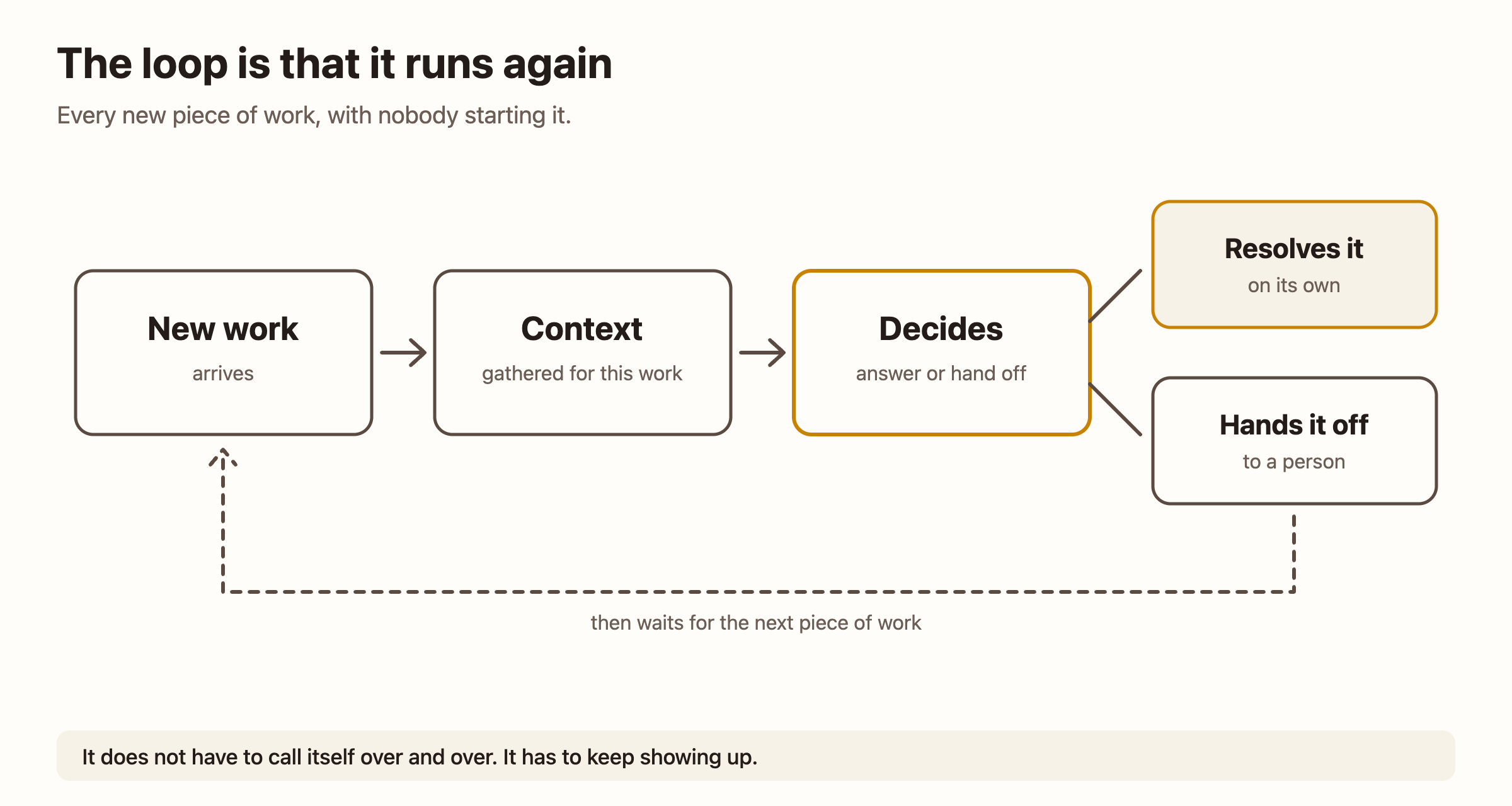
No. The loop is that it runs again and again, on every new piece of work, without being asked.
When people say loop they often mean a model calling itself over and over inside one task until it is done. That is one kind. The loop that matters to a business is simpler: an email arrives and it is handled, then the next one arrives and it is handled, at three in the morning and on a holiday, with nobody deciding to run it.
Does an agent have to finish the whole job?
No. Knowing where its part ends, and handing the rest to a person, is what a well-built, context-engineered harness does.
Our integration agent takes a customer's request for an app we do not read yet, researches it, and builds the work out as far as a draft. People accept or refuse that draft. Nothing it writes goes live by itself. I do not think that makes it less of an agent. An employee who prepares a change and sends it for review has done their job.
The same goes for escalation. Our support agent sends anything about money, deletion, legal questions, security, a child's safety or an upset parent to me. Deciding when to answer and when to escalate is deciding.
What agents has Daywell built?
Four, and all four are switched on.
- Daywell itself. The reader that takes a parent's school email, the messages they forward and what they send over WhatsApp, and turns it all into the family's list. It is the most advanced of the four, and the one that supports the whole user base, every day, with nobody starting it.
- Felix answers a parent's questions about Daywell, inside the apps and on our help page, and can make a change for a parent when they confirm it. He is the most extensible of the four. How Felix works.
- The support agent reads email sent to our support address and either answers or escalates. How it is designed.
- The integration agent picks up a customer's request for a new app, researches it and builds it out for review. How it works.
The last three are the ones a parent or a customer talks to, and each has its own post.
Is an AI agent just context engineering?
Mostly, yes. What separates my agents is not the model. It is what each one is shown, and what it is allowed to do.
Take Felix. He answers a parent's question from what Daywell knows about itself, and he can act as well as answer: he prepares the change, shows them what will happen, and does it when they tap to confirm.
The support agent and the integration agent came later, and I did not start either one from nothing. I took what worked in Felix and changed the context.
| Agent | What arrives | The context it is given | What comes out |
|---|---|---|---|
| Felix | A parent's question | What Daywell does and how to do it | An answer, or an action they confirm with one tap |
| Support agent | An email to support | The same knowledge, plus the few facts it may see about their own account | A reply, or an escalation to me |
| Integration agent | A request for a new app | The request, plus what public pages say about that app | A brief and a draft, for my PM operator to review and send to me |
None of the hard work was in the model. It was in deciding what each agent is shown, what it is never shown, and what happens to its answer.
How does an agent get better over time?
Put a second loop around it: read what happened every week, and turn what you learn into work for the team.
An agent that runs forever on its first design gets worse, because the world moves. So once a week a learning loop reads three things: what parents told us was wrong, what they did in the product, and what the logs say failed. It reads counts and patterns, never anyone's words or names. Then it writes improvement tickets, and the team works them before the next read.
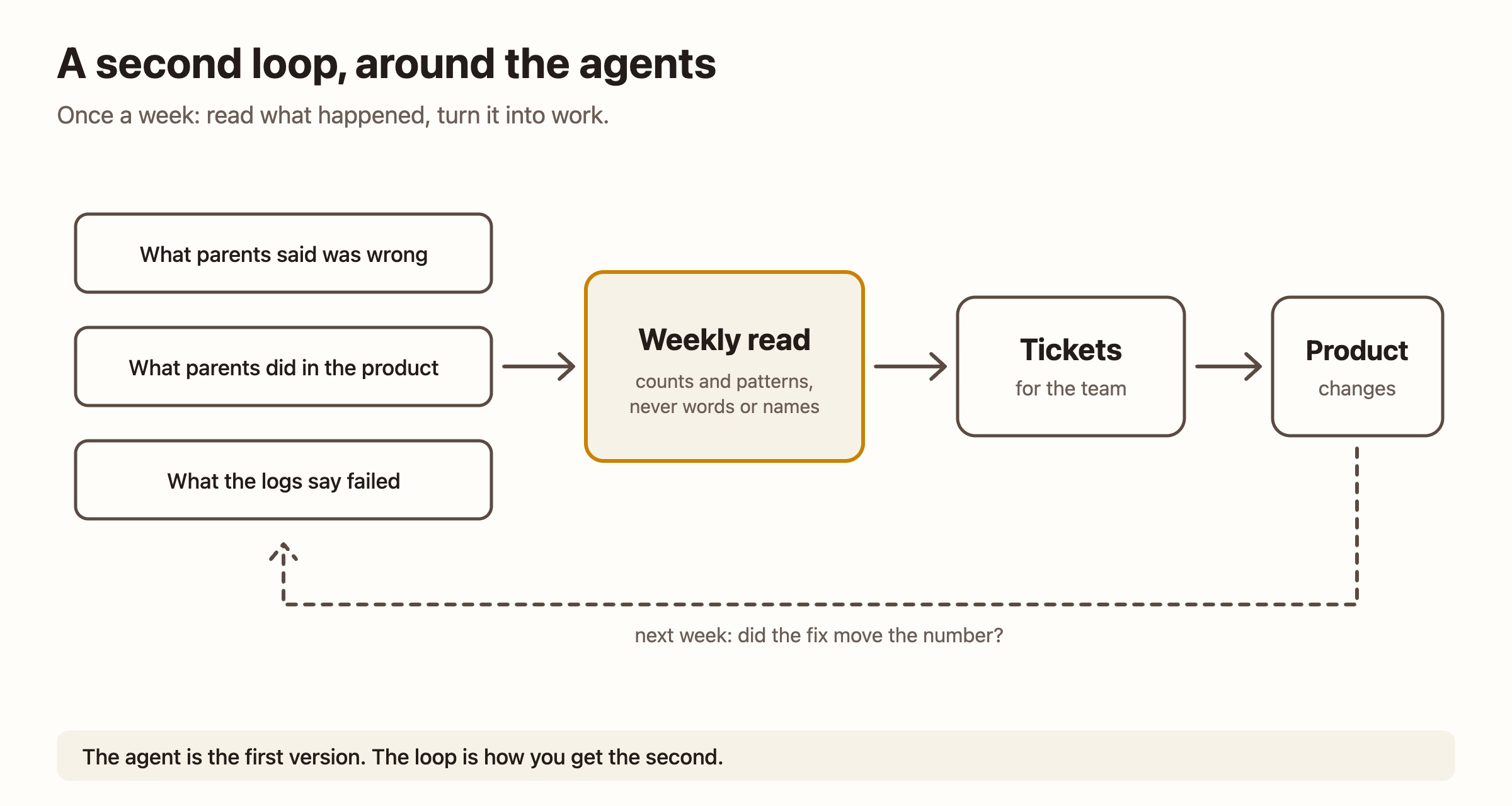
The part I like most is that parents rarely report a mistake, but they act all the time. A card a parent removes, edits or adds by hand is a quiet signal that something was off. The loop treats each of those as a clue and checks the following week whether the fix moved the number.
What I would tell another founder
- Say what you mean by agent before you compare notes. Most arguments about agents are arguments about the word.
- Start from the work, not the tools. What arrives, what should happen to it, and who gets the hard cases.
- Make escalation a first-class outcome. An agent that knows what it should not answer is worth more than one that answers everything.
- Let people review what matters. Finishing part of the job well still counts.
- Build the learning loop early. The agent is the first version. The loop is how you get the second.
- Build one good solution, then change its context. The second and third agent are mostly the first one, shown different things.
Daywell (getdaywell.com) reads a parent's school and daycare email and turns it into a short list of what to have ready, and when.