Felix is mostly context: one AI solution, many doors
By James Boone, 20 Nov 2026
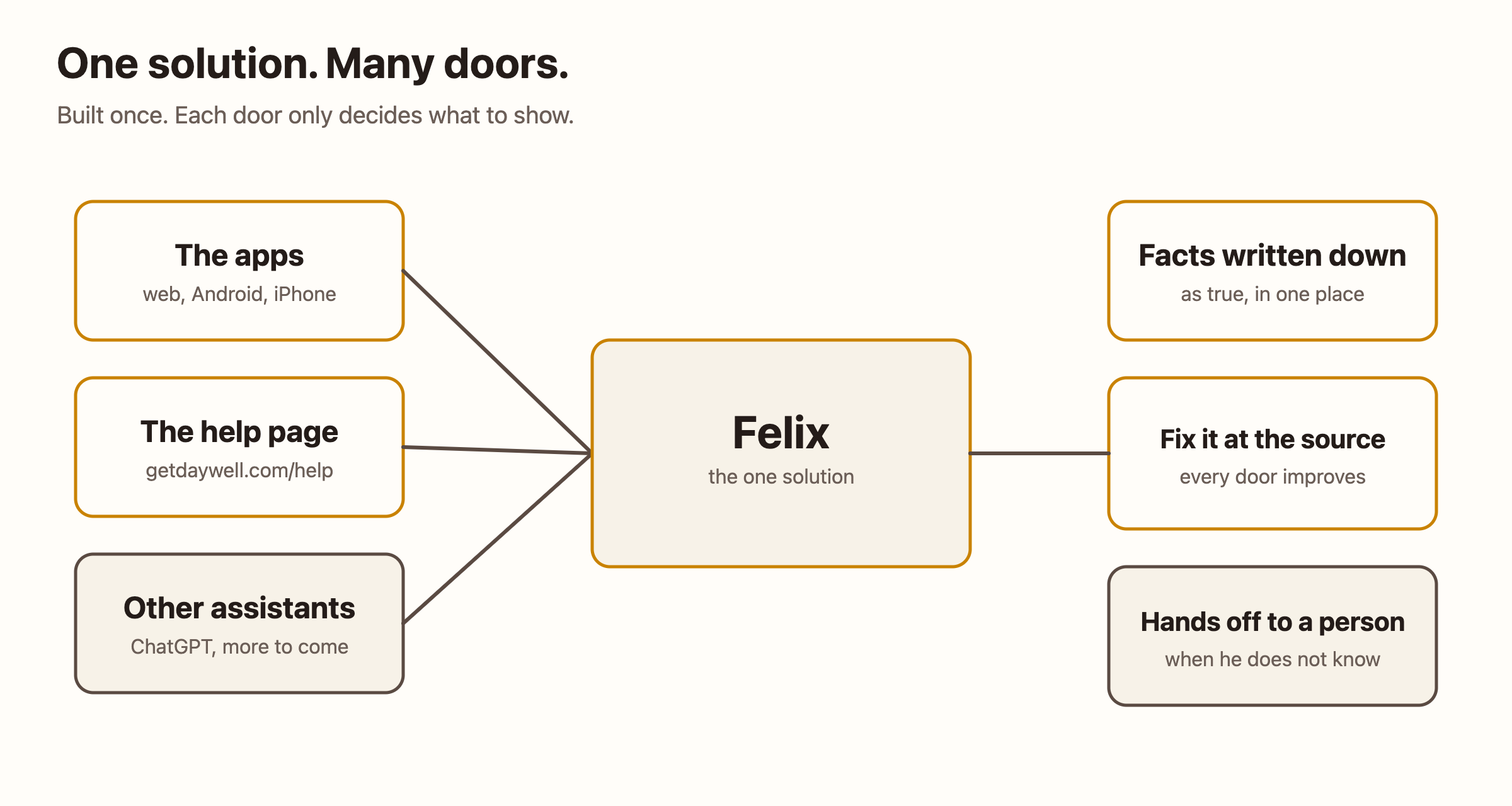
Felix is the agent a parent talks to when they have a question about Daywell. He answers them, and he can make the change for them. He is the most extensible thing I have built, and the reason is not the model. It is what the model is shown.
This is one of four posts on the agents inside Daywell. The first defines what an agent is.
What is Felix, and where does a parent meet him?
Felix is Daywell's help agent, drawn as a Ragdoll cat. A parent meets him in three places.
- In the apps. Felix lives in Messages. They ask in their own words.
- On the website. The "How can we help you?" box on getdaywell.com/help is Felix.
- In ChatGPT. A Daywell business agent there answers questions about Daywell from the same written knowledge.
In the apps and on the website, Felix says he is an AI helper.
Is Felix really an agent?
Yes. A question arrives, nobody starts anything, and Felix decides what to do with it.
An agent is an autonomous harness that runs a context loop and resolves work on its own. Felix has three moves: answer, make the change once the parent confirms it, or say he does not know and offer to pass the question to a person. Choosing between them is the work.
What did I want Felix to do that he could not?
More than give instructions. The first version could only explain.
The first time I tried him on my own iPhone, I asked a simple question: how do I add my wife? The answer was correct, with one link. I called it "OK but not great". I wanted three things from the next version:
- Do things, not only explain them.
- Know everything about Daywell, and cost very little to run.
- Almost never say "I don't know". A parent who hears that twice will not ask again, and there are enough AI assistants out there that do that already.
The second version was built for all three. Felix now prepares a change, such as moving a card to another day, turning the morning reminder on or cancelling an invite. He shows them exactly what will happen, and does it when they tap to confirm.
Where should an AI help agent get its answers from?
Only from facts that are already written down as true somewhere else. Then a wrong answer is a wrong source, and you fix it there.
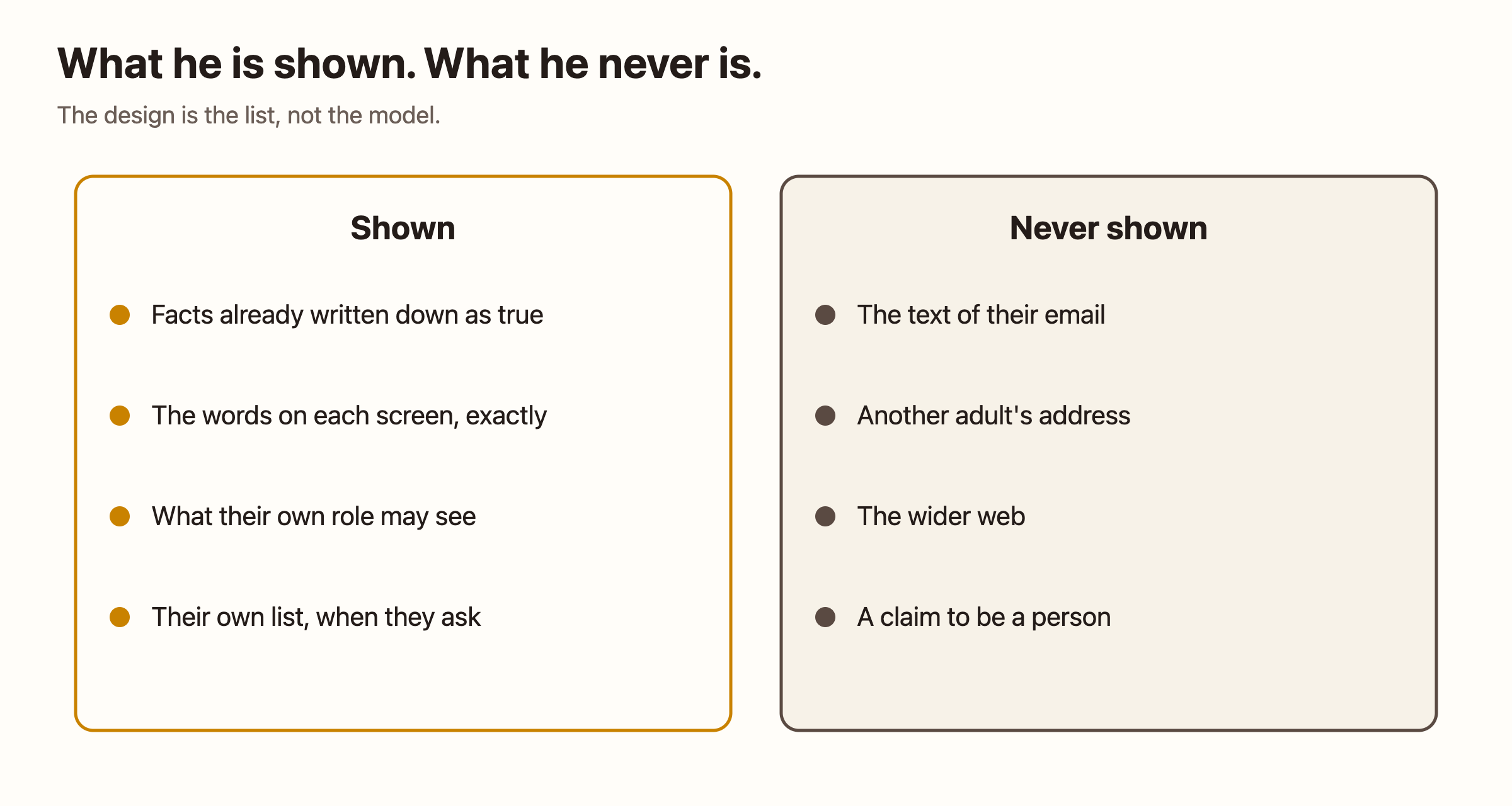
The first Felix answered from a short list that somebody typed by hand. He said "I don't know" far too often, because most of what Daywell knows about itself lived elsewhere: what each way into the app does, which apps work today, the words on each screen, the plans, the privacy page.
The second Felix reads from those places directly. Nobody types a fact into Felix. If he is wrong, I fix the place the fact lives, and he is right everywhere at once.
That is context engineering. The model is a commodity. What Felix is shown decides how good he is.
| What Felix is shown | What he is never shown |
|---|---|
| Facts already written down as true | The text of a parent's email |
| The words on the screens, quoted exactly | Another adult's address |
| What their own role is allowed to see | The wider web |
| Their own list, when they ask about it | A promise the product does not keep |
What should an AI agent do when it does not know?
Say the closest thing it does know, offer a person, and count the miss. A dead end is a failure worth measuring.
For Felix, "I don't know" is never the safe answer. Each one goes on a weekly list of gaps, and each gap gets closed by writing the missing fact down where facts live.
I judge him on three numbers side by side:
- How often he was unsure.
- How often a parent tapped "Not really" on an answer he was sure about.
- How often a parent passed a question to a person after a confident answer.
A model grades itself kindly, so it is never the only judge.
A helper that says "I don't know" to everything is worse than no helper.
Should an AI help agent ever pretend to be a person?
No. Felix says he is an AI helper, every time, and he stays on his subject.
- He only knows Daywell and the family's schedule. An off-topic question gets exactly that answer. He does not search the web.
- He never acts without the parent's tap. They see what will happen first.
- He never does what cannot be undone. Removing a family member or deleting an account is the parent's to do. He explains it and opens the right screen.
- He hands off cleanly. If a question needs a person, the parent can pass it on. They see exactly what will be shared before they agree: that question and the few messages around it.
What does one solution behind many doors mean?
The solution is built once. Each place a parent might ask is a door into it, with the context that door needs.
I did not build one helper for the app, another for the website and another for each assistant. The same Felix stands behind every door:
- Inside the Daywell apps, in Messages.
- On the website, behind the help box.
- Inside other assistants, starting with ChatGPT, so a parent can ask where they already are.
Other assistants reach Felix through an MCP server that carries his name. It is designed as one server with the same few tools for every assistant, and no code written per assistant. At that door Felix does not do the talking. The other assistant's model does, and Felix hands it the family's list.
Why is Felix the most extensible of my agents?
Because the hard work is the context, and context travels. A new door is mostly a new place to put the same solution.
- One brain. What Felix knows is written down once.
- Many doors. Each place he appears is a thin layer that decides what to show and what to hand off.
- One list of what must never happen, the same at every door.
The other agents came out of him. The support agent is the same idea aimed at email, with a list of questions that always go to a person. The integration agent is the same idea given a customer's request for a new app, and asked to prepare work for review.
How can a parent tell Felix an answer was wrong?
They tap that it was not what they needed, or they pass the question to a person. Both feed the weekly learning loop.
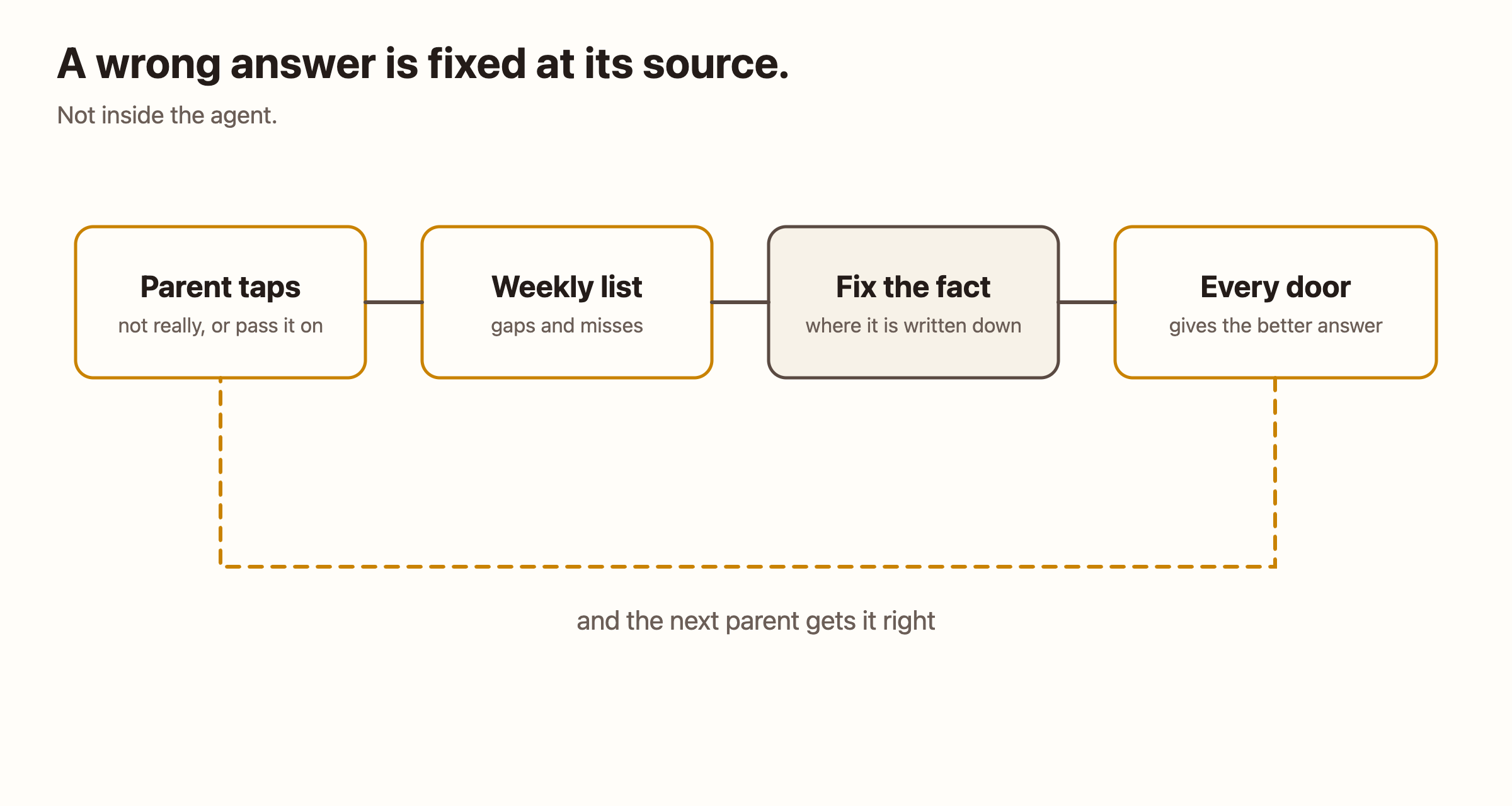
The apps count three taps: "helped", "not really", and passing a question on. They count the tap, never the words of the question. Every week the learning loop reads those counts next to the list of gaps, and the fix lands where the fact is written down.
What I would tell another founder
- Write the facts down once, and have the agent read from there. Never type an answer into the agent.
- Fix wrong answers at the source, so every door gets better together.
- Treat "I don't know" as a failure to measure, not as the safe answer.
- Decide what the agent is never shown before you decide what it is shown.
- Make every door a thin layer over the same brain.
Daywell (getdaywell.com) reads a parent's school and daycare email and turns it into a short list of what to have ready, and when.