Do AI assistants recommend your app? I built a small weekly tracker to find out
By James Boone, 18 Nov 2026
I run Daywell alone. It reads the school and daycare email a parent gets and turns it into a list of what to have ready, and when. A parent who asks an AI assistant "is there an app that reads my kid's school emails" is a prospect with a clear need, so I wanted to know, every week, whether the assistants name us. Commercial tools for this are priced for bigger companies, so I built a small tracker. This post covers how it works, what it costs, and my early misreadings.
The short version: on the everyday questions we were named in 4 of 72 answers in the latest run, up from 0. That is close to zero, and the useful part is why.
How can I tell if ChatGPT or Claude recommends my app?
Ask the same fixed questions every week, through each assistant's API with web search on, and score every answer.
Once a week, on Sunday night, a scheduled job asks the same parent questions to four assistants through their APIs: Claude, ChatGPT, Gemini and Perplexity. Web search is on for all four, because a parent's question about apps is exactly the kind of thing an assistant looks up.
For every answer I store the raw text and the cited URLs, then score:
- Named: the whole word "Daywell" or our domain appears in the answer.
- Cited: any cited URL is on our site. I keep this separate from naming, because an assistant can cite a page and not say the name, or the reverse.
- Competitors named: one cheap model pass lists the products in the answer. A negative mention is flagged and not counted.
- Wrong claims: for questions about Daywell itself, I keep a short list of true facts (read-only Gmail access, we keep the to-dos and not the emails, no ads, which platforms) and ways to get each wrong. An answer is flagged only when it quotes words that contradict the fact, and a second check confirms it.
The tracker sends only public questions I wrote. It involves no parent data.
How do I choose the questions for tracking AI search visibility?
Write them in a customer's words, not a marketer's, and never edit one once asked. Rewording hides whether the assistant changed or you did.
I started with 25 and wrote them in a parent's words, not a marketer's. They cover problems ("I keep missing things from my child's daycare emails"), the tools schools use, solutions ("is there an app that reads school emails"), comparisons, and a few about Daywell by name.
The rule that matters: the text of questions 1 to 20 is never edited once asked. If you reword a question, you can no longer tell whether the answer changed because the assistant changed or because you did. A trend needs a fixed ruler. New questions get new numbers and a date. We are at 40 now.
The headline number uses only the everyday questions, 18 of them. Questions about Daywell by name are reported on their own, never added in, since an assistant asked about us will say our name.
How much does it cost to track AI search visibility?
For me, about $3 a weekly run, under a $25 monthly ceiling. It started lower.
My first estimate was about $0.90 per weekly run, around $4 a month, with a ceiling of $15. Each provider is prepaid or has its own spend limit, and the job skips itself if it would pass the monthly ceiling.
That estimate broke when I improved the Claude setting (more on that below). Claude on a larger model with two searches costs about $3 a run, because search results come back as input tokens. A month with five Sundays is about $15, so I raised the ceiling to $25. Each run is 160 answers (40 questions, four assistants); the latest had no errors.
Do cheap API settings give the same AI answers a real user sees?
Not always. Cheap settings read fewer sources, so check a question by hand, logged out, before trusting a zero, and read the tracker over weeks.
To keep cost down, ChatGPT is asked on a small model at low reasoning effort, and Perplexity on its fastest preset. Cheap settings read fewer sources, so those two may be the hardest case.
So before trusting a zero, I tested by hand: logged out, no history, a temporary chat. I asked ChatGPT nine of the same questions, once each. Daywell: 0 of 9. Perplexity allows one question when logged out, so that was 1 question, and 0 of 1. The same answer as the cheap API.
Two details changed what I thought the problem was. On the two how-to questions, ChatGPT did not search at all, so no site work can win them. On "is there an app" questions it named small, new apps, so being small is not the wall; one free web app was ChatGPT's first pick on 3 of the 4 "is there an app" questions. It has fewer pages than we do. It is free and we charge $9.99 a month after a free first week, which I suspect matters and cannot test.
One caution. A single preprint I read found that 41 to 45 percent of the pages ChatGPT cited appeared in only 1 of 20 identical runs, and that API answers overlapped the app's by only 16 to 23 percent. One ask a week will catch and miss you by chance, so I treat the tracker as a site-level signal over weeks, not a photograph of what a parent sees.
Why don't ChatGPT and Perplexity mention my website?
Often because their crawlers have barely read it.
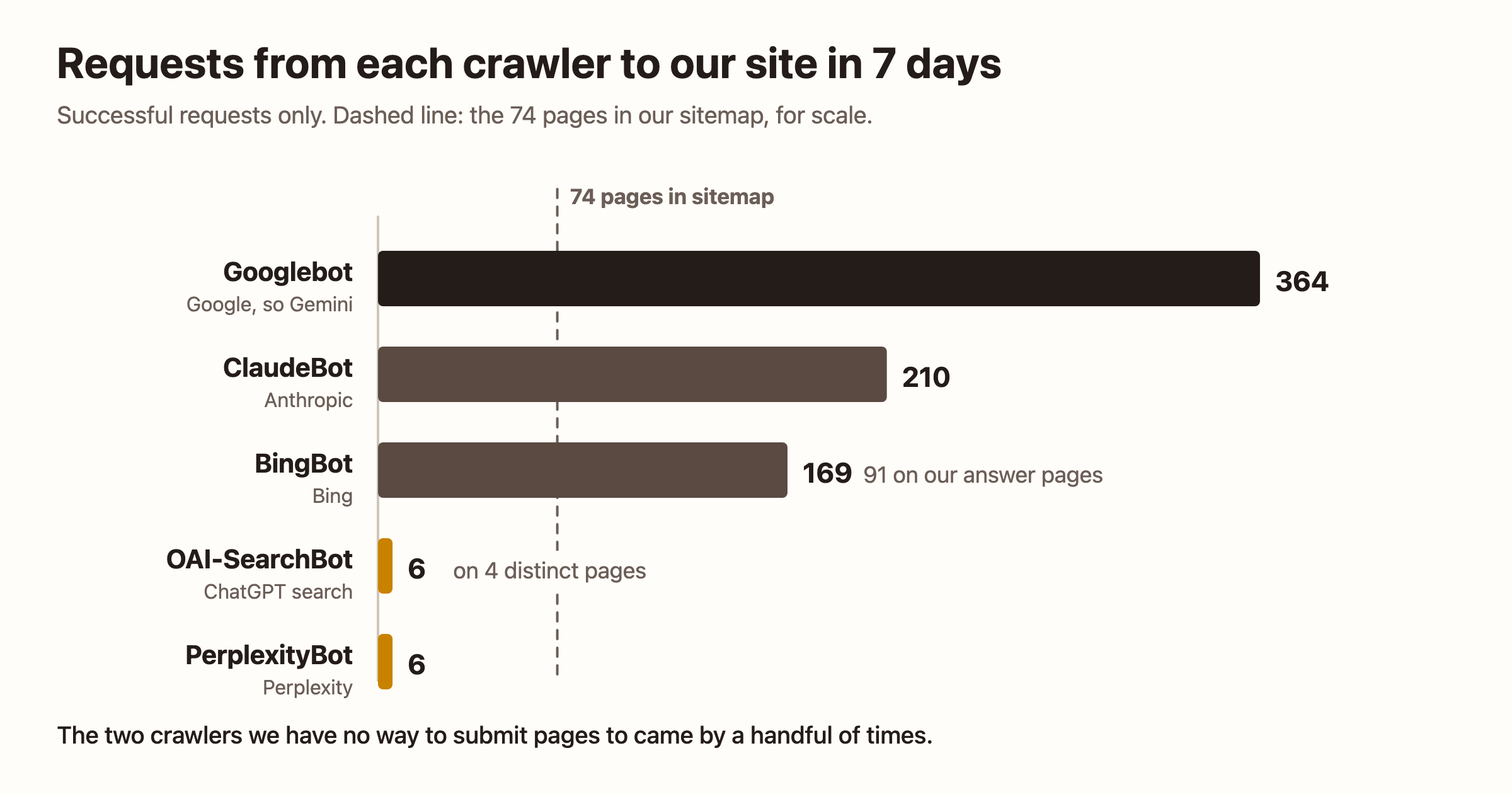
Each assistant answers from its own search index, and I had only fed two of them. Here is what Cloudflare's AI Crawl Control showed for our site over seven days, against 74 pages in our sitemap:
| Crawler | Index it feeds | Requests that succeeded in 7 days |
|---|---|---|
| Googlebot | Google, so Gemini | 364 |
| ClaudeBot | Anthropic | 210 |
| BingBot | Bing | 169 (91 on our answer pages) |
| OAI-SearchBot | ChatGPT search | 6, on 4 distinct pages |
| PerplexityBot | Perplexity | 6 |
I submitted every new page to Google and Brave by hand, and the site pings Bing. For OpenAI and Perplexity there is no submission route that I could find; neither publishes one. Their crawlers follow links, and with almost no sites linking to us they had read a handful of pages. At that point the two assistants that had cited us, Gemini and Claude, were the two whose indexes I fed. Perplexity has since cited us for the first time, in the latest run. I should say that Claude's search being backed by Brave's index is reported but not confirmed by Anthropic.
Not blocked: our robots.txt only closes our own app and admin paths, and each crawler's user agent got the full page.
One side finding: Cloudflare also reported failed requests under AI crawler names, 778 of 789 failures being 404s. They were vulnerability scanners wearing AI bot user agents and asking for environment and credentials files. Without separating successes from failures, you will think the bots are hammering you.
One hopeful sign: BingBot read our answer pages 91 times while Bing's webmaster report still said "discovered, not crawled". ChatGPT search is widely reported to lean on Bing; that is unconfirmed. I will re-read it in a week.
Why did my AI visibility jump in one week?
Check whether you changed how you measure before you credit the site.
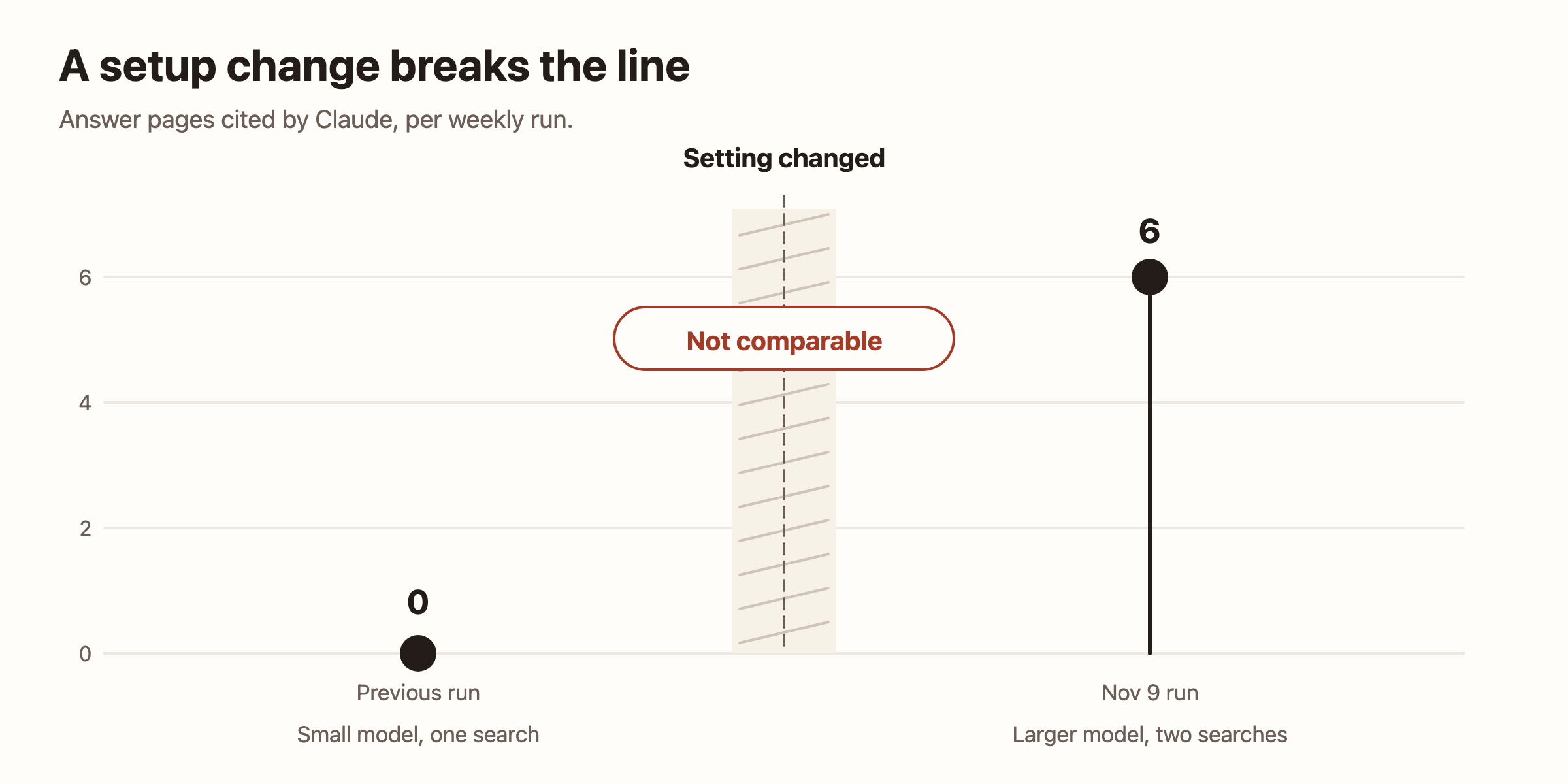
In the run of November 9, Claude went from citing none of our answer pages to citing six, each one for the exact question it was written for. I nearly wrote that up as the site working.
But it was also the first run on a new Claude setting: I had moved it from a small model with one search to a larger one with two. More searching reads more of the web, so more of our pages can appear even if the site did not change. I had logged the change, then wrote up the result without reading my own log. The two weeks are not comparable.
The lesson is dull and important. Every change to the measuring setup goes in a log with a date, and a number is only a trend if the setup behind it stayed the same. If you want to improve the setup, accept a break in the line and mark it.
Should I report AI visibility as one total or by question group?
By group. A merged total hid that most of our movement came from questions that already name us.
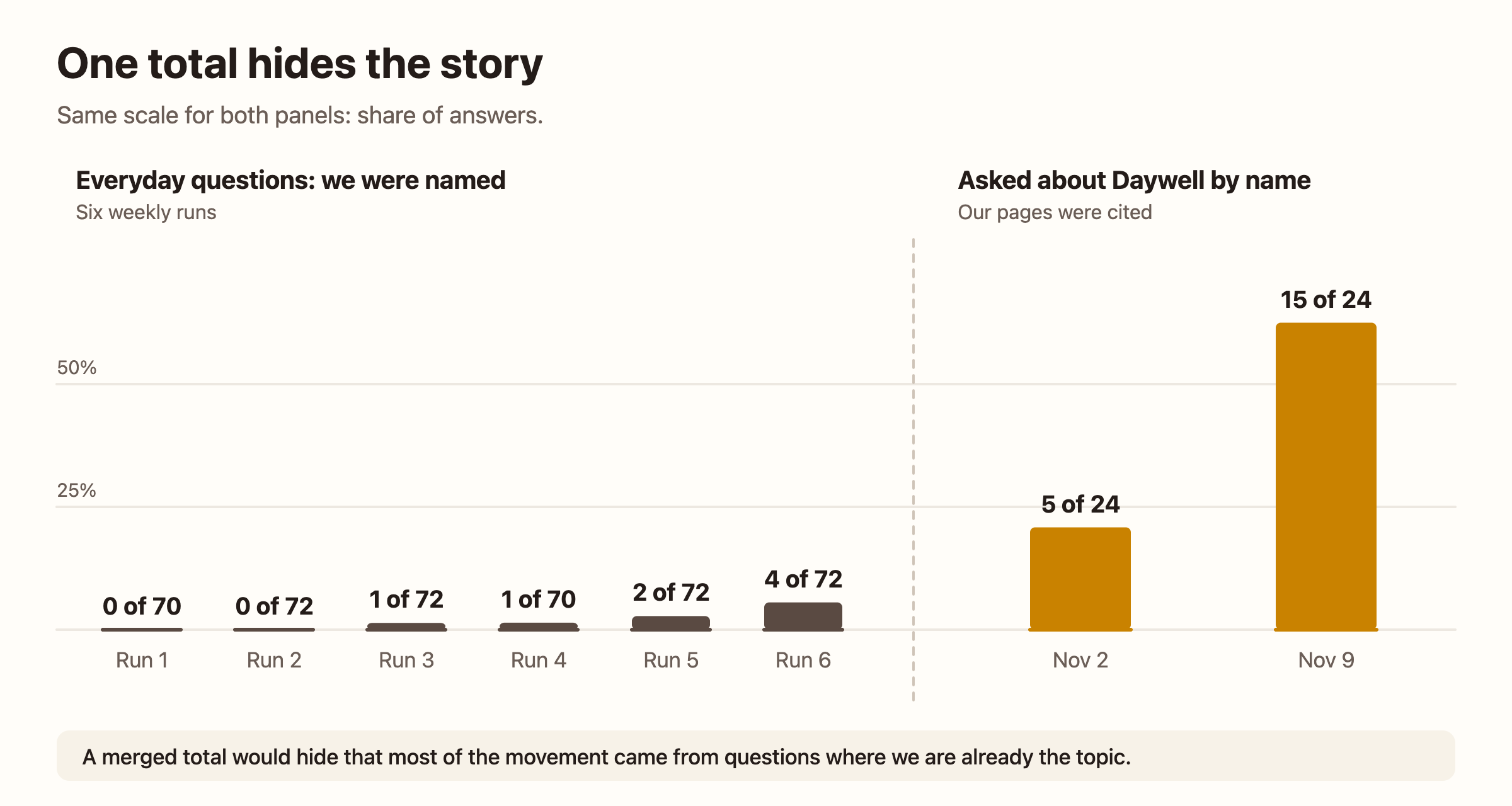
The same results, as named and cited out of answers, for the everyday questions across six weekly runs:
- First two weeks: 0 of 70, then 0 of 72.
- Next three weeks: 1 of 72, 1 of 70, then 2 of 72.
- Latest week: 4 named and 5 cited, of 72.
The questions about Daywell by name tell a different story: our own pages were cited in 5 of 24 answers on November 2 and 15 of 24 on November 9. A merged total would have hidden that most of the movement came from questions where we are already the topic. On the first run, 0 of 21 answers about Daywell by name described us; the assistants confused us with an unrelated UK product of the same name.
I now report one row per group, one column per week, each cell showing named, cited and the base, plus a headline row per assistant. As of the latest run, ChatGPT has never named or cited us on the everyday questions. Perplexity named us for the first time, on one answer. Gemini named and cited us on one answer in three runs in a row, then on none in the latest. Claude named us on 0, then 1, then 3 of its 18 answers over the last three weekly runs, across the setup change described above.
The accuracy check earned its place: one price answer on Claude is still wrong, and I treat that as a bug in my own pages.
How do Grok and Meta AI find websites?
Both lean on social content, and neither can be fed by a sitemap. Neither is in my tracker yet; I check Meta AI by hand each month.
I did not add them to the tracker. I could not confirm a search API for Meta AI, and Grok's would need a separate build. What I could read:
- Meta AI has its own crawler for AI search, plus separate ones for model training and for fetching a link a user pastes. Press reports say its AI search also draws on public Facebook, Instagram and Threads posts; Meta's documentation does not say so. It documents no submission tool.
- Grok is the murkier one. xAI's docs say it searches the web in real time and has a tool for posts on X, and name no index, search partner or crawler. One blogger's logs suggest its page fetches arrive disguised as ordinary browsers. That is a single source, unconfirmed.
Both lean on social content, and neither can be fed by a sitemap. Meta AI now joins my monthly logged-out check by hand, and we are starting public posts that link to our answer pages. No results to report yet.
Takeaways for tracking AI visibility
- Freeze your questions. Add new ones with a date. Never reword an old one.
- Log every change to the setup, including the ones that improve it, and do not compare across the break.
- Test one question by hand, logged out, before you trust an API zero. Do it again before you celebrate a gain.
- Read the crawler logs next to the tracker. If an assistant's crawler read under 10 of your pages in a week, your problem is discovery, not wording. Count only successful requests.
- Report by question group and by assistant, with the base in every cell. One week is a hint; two in a row is a trend.
Daywell (getdaywell.com) reads a parent's school and daycare email and turns it into a short list of what to have ready, and when.